By Lizzie Macaulay
I’ll let you in on a secret that won’t shock anyone who has met me. My jewellery box is a graveyard of good intentions. Tangled chains, a single earring whose twin left home years ago, and enough costume sparkle to outfit a primary school dress-up day. None of it worth much. All of it headed, eventually, for landfill.
Not that I don’t try. I’ve enormous intentions of shopping sustainably, and we do our best where we can. The real challenge, as any parent will tell you, is keeping up with children who refuse to stop growing the moment you turn your back. Shoes outgrown in a season, uniform dresses that should sit at the knee riding up well above it by term three. That’s where good intentions meet reality.
Still, it feels worth the effort wherever you can manage it, and if there’s one place buying well and buying once really earns its keep, it’s in the things made to outlast a growth spurt entirely. So when this month’s sustainability theme led me to World Treasure Designs, a jewellery house built entirely around the idea of making one good thing that lasts, I arrived ready to have my habits gently held up to the light.
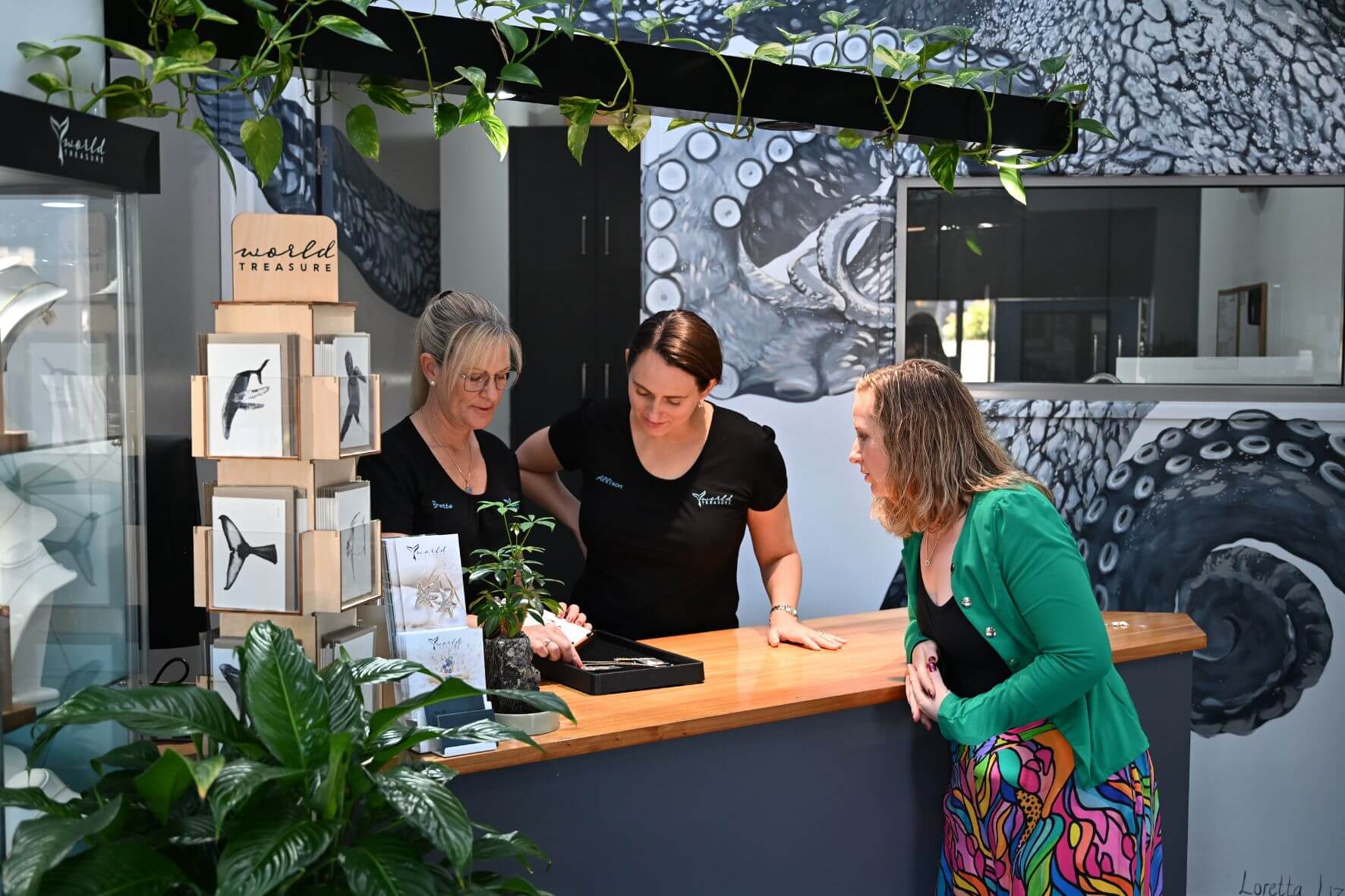
The studio was built from the ground up about seven years ago, and it’s a proper family affair. Allison looks after the marketing, the website and the photography, while her husband Nick runs the workshop and the manufacturing. The craft is in his blood, going back generations. His grandfather opened the first of the family’s jewellery stores in Tasmania in 1948, and it’s been handed down ever since, the way the best things are.
Their ocean collection is what most locals will recognise, the whales and turtles and sharks you’ll spot in cabinets at the island resorts and the visitor centre. But behind the pretty things is a story I hadn’t expected, and it starts with a small, unassuming lump of carved metal.
Allison talked me through how a piece is born. It begins as what they call a master, often hand carved, sometimes drawn up on a computer for the really intricate designs. I held the master for a whale shark, every scale and circle coaxed out by hand, and it stopped me for a moment. Someone sat and made that, patiently, from nothing.
From the master a mould is taken, and from the mould the metal is cast, the pieces emerging in clusters on what the jewellers cheerfully call a tree. Then comes the polishing, the texturing, the setting. A flat idea, slowly, becomes something you can wear for the rest of your life.
I learned that jewellery-making is far less dainty than it looks. It’s hot, physical, fiddly work. Hands get burnt, joints ache, and setting a single tiny stone under a microscope calls for the steadiness of a surgeon. I got to peer over a setter’s shoulder as she worked, and spied a microscope for detail work that can be wired up to a screen, turning jewellery-making into a spectator sport for curious customers. It made me think of every time as a kid I ever came across a chocolatier or candy maker putting their craft on display to salivate over… perhaps this is the adult equivalent?
Every finished piece is stamped. A little whale tail, the studio’s own hallmark, sitting alongside the mark that tells you exactly what the metal is. Allison explained that jewellery is one of those purchases built almost entirely on trust, and that little stamp is a promise, a maker putting their name to their work. Watching how much of it happens right there in the room, nothing sent away, nothing outsourced, I understood why people hand these folks their most precious heirlooms without a second thought.
And here is where the sustainability theme quietly earned its place. So much of what they do comes down to knowing where things come from. The metal is recycled wherever possible, melted down, refined and alloyed back into use right there in the workshop. The gold they buy is Australian mined, which comes with strong environmental and labour standards and, just as importantly, the reassurance of knowing its origins. The gemstones are largely Australian too, opals and sapphires and South Sea pearls, sourced as directly as possible from the small miners who dig them. These tend to be modest operations, much of the work done by hand, and where the miners are required to fill their claims back in and let the land recover once the digging is done.
My favourite detail was the most human one. People bring in jewellery from loved ones who have passed, boxes of odd bits nobody would ever wear as they are, and the team melt it down and remake it into something wearable again. Precious metals never really die. They just wait quietly for their next life.
That idea sits at the very heart of the operation. They offer what they call a Forever Guarantee, and they mean it fairly literally. If a piece ever fails through a fault in the making or the materials, they repair or replace it, free of charge. The jewellery, Allison told me, should outlast the person who bought it, and be passed down for generations. Buy well, buy once. It’s sustainability from long before the word was ever fashionable.
They back it up beyond their own four walls, too. As members of 1% for the Planet, they commit at least one per cent of their revenue each year to environmental causes, most of it directed at ocean conservation, which feels only right for a business so shaped by the sea. Allison described it as a sort of voluntary earth tax, a way of giving back to offset the footprint any business inevitably leaves. Small on its own, she admitted, but the whole point is the collective. Lots of small businesses, all chipping in together.
I came home and looked at my sad little jewellery box with fresh eyes. Not with guilt exactly, but with a quiet resolve to do better. To buy the one good thing. To choose the piece made by people I could look in the eye, from metal and stones I could trace, built to be handed on rather than thrown away.
The whale tail stamped inside each piece is a lovely thing, when you sit with it. A tiny mark of the ocean, tucked where only the wearer knows it’s there, promising that this one was made to last. I rather like the thought of my grandchildren one day turning something over, finding that little tail, and knowing it was made with purpose.
With thanks to Allison and Nick at World Treasure Designs for opening their workshop to us.
You’ll find them at 32 King Street, Hervey Bay QLD 4655, or browse the collections any time at worldtreasuredesigns.com.
Visit – https://worldtreasuredesigns.com