Written by Lizzie Macaulay
Regular readers of this column will know by now that while I dive head first into new adventures with boundless enthusiasm, my execution doesn’t always quite match my ambition.
My eagerness to dive into new experiences is rarely matched by natural talent, but I’ve learnt to embrace the journey regardless.
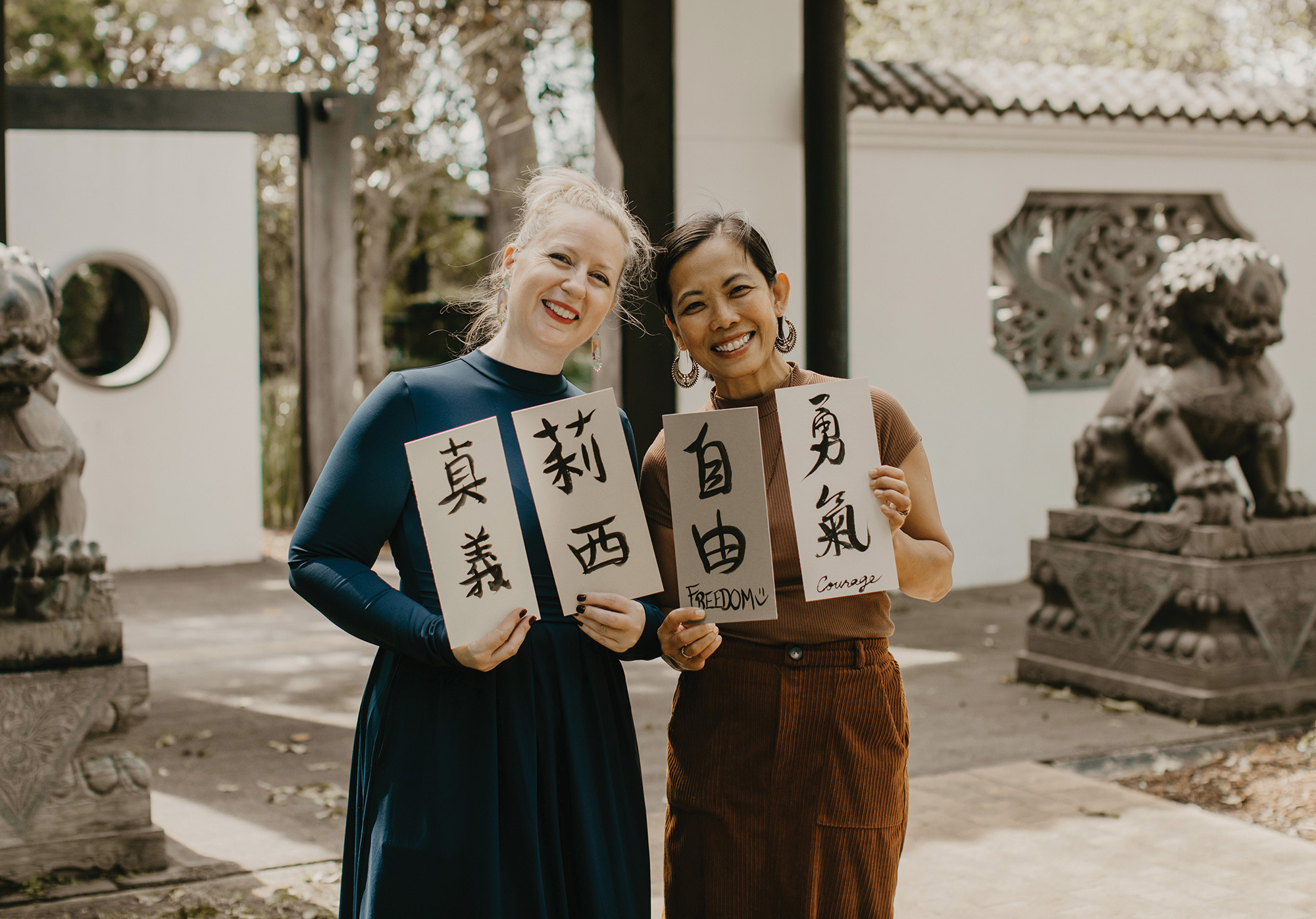
With this edition’s theme of ‘immigrants’ in mind, I had the extraordinary privilege of spending time with someone who’s not just my business colleague, but a dear friend of more than a decade – Joy Butler, the founder of this very magazine.
Her meticulous attention to detail, remarkable skill and boundless creativity are woven into the fabric of everything she creates, and I was about to get a rare glimpse into an art form deeply connected to her cultural heritage.
On a gloriously sunny morning, we met at the Chinese gardens in Urangan’s Botanic Gardens – a setting that couldn’t have been more perfect for my introduction to Chinese calligraphy.
The tranquil surroundings with their blend of manicured nature and thoughtful design felt worlds away from my often-chaotic life and the endless to-do lists that typically dominate my days.
I couldn’t help but notice how this choice of location embodied something I’ve always admired about Joy – her ability to create space for creativity and soulfulness amidst the whirlwind of running multiple successful businesses.
It’s a practice I aspire to, but haven’t quite mastered… yet.
Lesson one was already underway before a drop of ink had been used.
As Joy carefully unpacked her calligraphy kit, I was struck by the reverence with which she handled each item.

The set – brought over from Hong Kong by her mother – was immaculate, each piece meticulously arranged.
The care evident in this simple act spoke volumes about the importance of this tradition to Joy.
Joy guided me through the basics, explaining how each character is made up of individual elements, and each element has its own meaning.
I nodded enthusiastically, while internally wondering if I’d bitten off more than I could chew.
As a word enthusiast who loves language in all its forms, I was instantly captivated by the idea that this wasn’t just about creating beautiful shapes – it was about layering meaning upon meaning in a visual poetry.
Complicated? Absolutely.
But also deeply romantic to someone who spends her days wrangling language.
Our first task was preparing the ink – a process that immediately grounded me in the ritualistic nature of the practice.
We wet and ground the precious ink stick, creating the deep black medium with which we’d work.
Joy demonstrated how to carefully stroke the brush through the ink to maintain its delicate point, a precision that would prove crucial for what followed.
Joy showed me how to hold the brush as if cradling an egg in my palm, while letting my wrist and arm flow naturally during the strokes.
Right. Controlled yet fluid. Precise yet flowing.
For someone whose handwriting has been described as “enthusiastically illegible,” this was a tall order. cringe
My first attempts were predictably clumsy – hesitant, awkward strokes that bore little resemblance to the elegant examples Joy had created.
If you’ve ever watched a master chef effortlessly julienne vegetables and then tried to replicate it, only to produce a pile of misshapen chunks, you’ll understand exactly how I felt.
The distance between intention and execution was… substantial.
Joy, bless her, remained encouraging throughout.
I know it must have been a touch painful for her to watch me butcher an art form she’s practised since childhood.
Everything artistic that Joy touches emerges with elegant sophistication – I, on the other hand, am not so naturally blessed.
But if enthusiasm counts for anything, I was giving it my all.

As we worked through different characters and symbols, Joy guided me to add my own flourishes – small expressions of individuality within the structured forms.
Like any skill worth learning, there was a curve to climb, and I was firmly at the foot of it.
But with each attempt, I could see tiny improvements – strokes becoming slightly more confident, proportions slightly less haphazard.
Joy gently reminded me that nobody is masterful the first time they try something new.
Coming from someone whose work consistently embodies mastery, this reassurance carried special weight.
What struck me most about this experience wasn’t the skill itself – though it was fascinating – but the window it opened into Joy’s heritage and identity.
This wasn’t just a hobby she’d picked up; it was part of her essence, an art form she’d learnt as a child and recently chosen to reconnect with.
In teaching me these basics, she was sharing something deeply personal, a thread that connected her to her roots.
For all my bumbling attempts and crooked lines, I felt honoured to participate in this exchange.
There’s something powerful about learning an aspect of someone else’s culture directly from them – especially a friend you thought you knew well.
After more than a decade of working side by side, this experience revealed dimensions of Joy I hadn’t had a chance to enjoy before.
As we packed up the elegant tools and I contemplated my modest stack of practice sheets, I realised that the true gift of the day wasn’t the introduction to calligraphy.
It was the brief immersion in a tradition that has travelled across eras and oceans, carried carefully like those delicate brushes, preserved and practised by immigrants who bring their cultural treasures to enrich our community.
My fingers may never master the precise dance of brush strokes that Joy demonstrated with such grace, but my heart is fuller for having glimpsed this beautiful connection between art, language, and identity.
Sometimes learning isn’t about achieving mastery – it’s about understanding something new about the world, and the remarkable people who share it with us.
With deep gratitude to Joy Butler for sharing her heritage, patience, and friendship. If you’re interested in exploring the Chinese Gardens at the Urangan Botanic Gardens, they’re open daily and offer a peaceful retreat for reflection and appreciation of this cultural treasure in our community.